If you run a small business that serves a local area, showing up in local search is no longer optional. It's the difference between a steady stream of customers who find you the moment they need you and a quiet phone that leaves you wondering where everyone went. This local SEO checklist for small businesses in 2026 walks you through every step that actually moves the needle this year, from the foundations that have always mattered to the newer signals that have completely reshaped how Google decides who shows up first.
Local search has changed more in the past twelve months than in the several years before it. The March 2026 Core Update pushed AI-generated answers deeper into local results, review expectations climbed, and Google now quietly penalizes businesses that let their presence go stale. The old playbook of setting up a profile once and forgetting about it doesn't just underperform anymore. It actively costs you rankings. This checklist reflects where local search actually stands right now, so you're optimizing for the version of Google that exists today rather than the one from two years ago.
Work through it in order. Start with the foundation, run a proper local SEO audit to see where you stand, and then layer on the pieces that compound over time. By the end, you'll have a clear, prioritized plan for getting found, getting chosen, and staying ahead of competitors who are still doing the bare minimum.
Start With a Local SEO Audit
Before you change anything, you need an honest picture of where you stand. A local SEO audit is the diagnostic step that tells you what's working, what's broken, and where the biggest opportunities are hiding. Skipping it is like a doctor prescribing treatment without an exam. You might get lucky, but you're just as likely to waste effort fixing things that were never the problem.
A thorough local SEO audit covers several areas. Start by checking how your business currently ranks in the map pack for your most important search terms, and do it from your actual service area rather than just your own desk, because rankings shift block by block across a city. Review your Google Business Profile for completeness and accuracy. Check whether your business name, address, and phone number are consistent everywhere they appear online. Look at your review count, average rating, and how recently reviews have been coming in. Test your website's mobile performance and load speed. Finally, see whether your business shows up at all when you ask AI tools like ChatGPT, Gemini, or Perplexity for the best provider in your area.
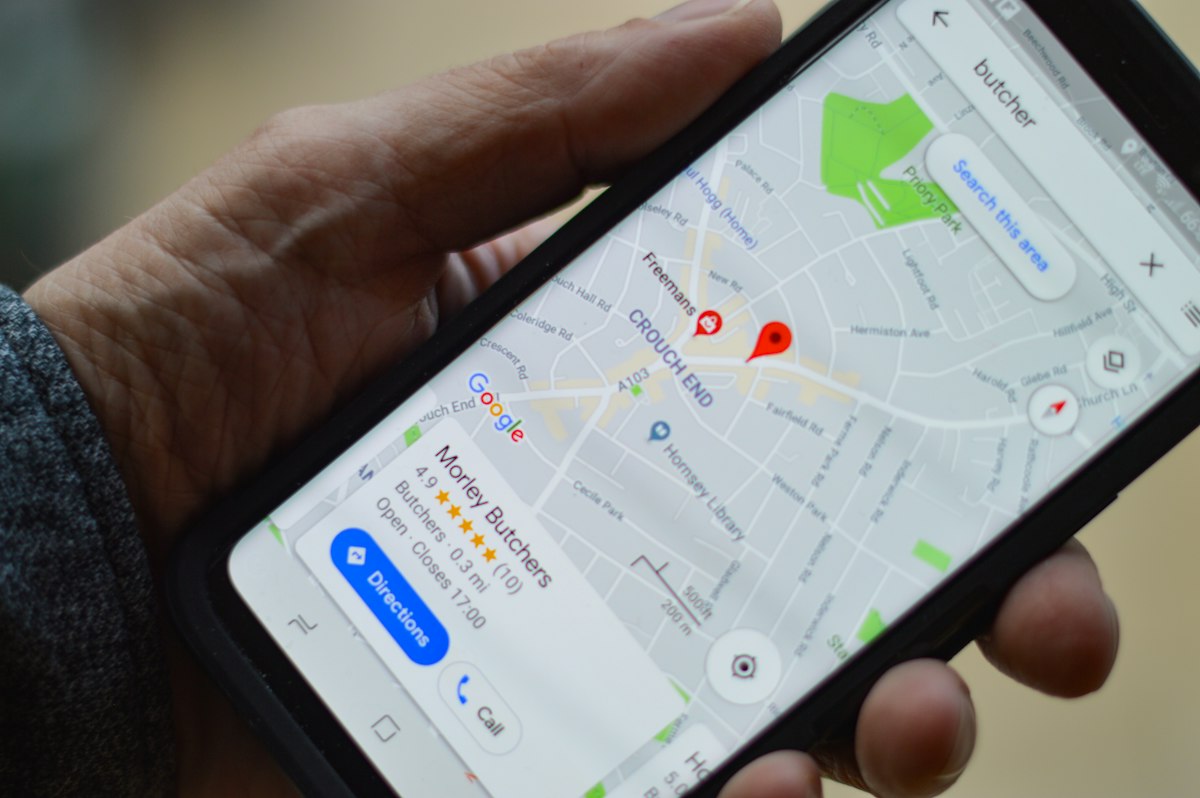
That last check is new and it matters more every month. AI usage for local search jumped dramatically over the past year, and a striking number of businesses that rank well in the traditional map pack are completely invisible in AI answers. Your local SEO audit should treat AI visibility as a first-class metric, not an afterthought.
Once you've completed the audit, you'll have a prioritized list of gaps to close. The rest of this checklist gives you the exact steps to close them. For a broader foundation, see our guide to SEO basics for service businesses.
Optimize Your Google Business Profile Completely
Your Google Business Profile is the single most important asset in local search, full stop. Industry studies consistently put Google Business Profile signals at roughly a third of everything that determines your map pack ranking, more than on-page SEO, reviews, or backlinks individually. If you do nothing else on this checklist, do this.
Completeness is the foundation. Every field you leave blank is a ranking signal you're throwing away. Fill out your business name exactly as it appears in the real world, and resist the temptation to stuff keywords into it. That used to be a sneaky ranking trick, but in 2026 it triggers policy enforcement and can get your profile suspended. Add your complete address or service area, phone number, website, and precise hours including holiday hours.
Your primary category is one of the strongest individual signals in the entire profile, so choose the most specific one that describes your core service. Then add relevant secondary categories to cover the full range of what you do. Write a detailed business description using natural language that reflects how customers actually talk about your services. Add your services and products with real descriptions rather than bare labels.
Photos carry serious weight now. Upload high-quality images of your actual work, your team, your location, and your finished results, and keep adding fresh ones. Google reads a steady flow of real photos as proof that you're an active, legitimate operation.

Here's the part most small businesses miss entirely: your profile has to stay active. Google now evaluates recent behavior more heavily than historical completeness, and profiles that go silent for thirty days or more get quietly demoted. A perfectly optimized profile that you set up once and abandon will lose ground to a less polished competitor who posts, responds, and uploads consistently. Treat your profile as a living marketing channel, not a one-time setup task.
Post Regularly and Keep Your Profile Active
Because activity is now a ranking factor in its own right, ongoing engagement deserves its own line on this checklist. Google Business Profile posts are one of the most underused tools available to small businesses, and they directly signal that you're open, active, and worth showing to searchers.
Aim to post at least once a week. Share promotions, seasonal offers, recent projects, answers to common questions, or company news. Keep each post short and direct, and end with a clear call to action like "Call now," "Book today," or "Get a quote." These posts appear on your profile and can surface in search results, giving you another surface to capture attention.
Beyond posts, keep the whole profile breathing. Respond to reviews within a day or two. Answer questions in the Q&A section. Update your services when they change. Upload photos from recent jobs. Each of these actions sends a small freshness signal, and together they add up to the kind of active profile Google rewards and static competitors can't match.
Build a Steady Flow of Reviews
Reviews have climbed in importance every year, and in 2026 they're more influential than ever, serving double duty as both a ranking factor and a trust signal that closes the sale. When a customer is choosing between a few local options, they almost always pick the business with more reviews, better ratings, and more recent activity. Reviews remove the fear of being the first person to take a chance on you.
The critical insight for 2026 is that velocity beats volume. A business with two hundred reviews and none in the last three months can get outranked by a competitor with eighty reviews that keep rolling in steadily. Google reads a consistent flow of new reviews as proof that your business is active and trusted right now, not just at some point in the past. So the goal isn't a one-time push to collect a big pile of reviews. It's a repeatable system that generates a few every single week.
The best moment to ask is right after you've delivered great work, when the customer is happiest. Make it effortless by texting them a direct link to your review page so leaving feedback takes seconds. And here's a powerful detail: prompt them to mention the specific service you provided. When a review says "great kitchen remodel" or "fast mobile detailing," Google connects that exact term to your business and treats it as proof you actually perform that service, which strengthens your relevance for those searches. For a full walkthrough of how reviews and local marketing work together, see our car detailing customer guide.
Respond to every review, positive or negative. A thoughtful, professional reply to a critical review often builds more trust than a dozen five-star ratings with no response. There's also a well-documented ranking jump when a profile crosses from nine to ten reviews, so if you're just starting out, getting to ten quickly should be an immediate priority.
Keep Your Business Information Consistent Everywhere
Consistency of your business name, address, and phone number across the web, often called NAP consistency, is one of those unglamorous fundamentals that quietly makes or breaks your rankings. Google cross-references your information across your website, your Google Business Profile, directories, social profiles, and third-party platforms to confirm you're a real, trustworthy entity.
When that information conflicts, even in small ways like "Street" in one place and "St." in another, or an old phone number lingering on a directory, it creates doubt. In 2026 those inconsistencies aren't treated as minor. They slow down how quickly Google trusts and indexes you, and they reduce your eligibility for competitive local searches.
Audit every place your business appears online and make the details identical everywhere. Prioritize the major directories and platforms, then work through smaller ones. Also sync your information to Bing Places and set up Apple Business Connect, because Apple Maps matters for iOS users and feeds into the broader web of signals that AI tools and search engines use to validate your business.
Build a Website Optimized for Local Search
Your Google Business Profile anchors your visibility, but your website is what supports and reinforces it. The two work as a connected system, and Google increasingly evaluates your business as a single entity across both. A strong website makes your whole local presence more durable.
Your site needs to accomplish two things at once: speak to humans and speak to machines. For humans, that means genuinely helpful, locally relevant content. If you serve multiple cities or neighborhoods, create a dedicated page for each one with real, distinct content about that specific area rather than the same paragraph with the city name swapped out. Google has gotten very good at spotting thin, templated location pages, and they no longer work. Dedicated service pages, one for each core service you offer, are consistently a top-tier ranking factor.
For machines, that means structured data. Add local business schema markup so search engines and AI tools can cleanly read your name, address, hours, services, and reviews. In an era where AI Overviews and answer engines pull information directly from structured data, proper schema is no longer a nice extra. It's how you make yourself legible to the systems increasingly deciding who gets recommended. Every page we build includes this markup by default — it's the same foundation behind our SEO basics approach.
Technical health matters too, though mostly as a floor rather than a growth lever. Your site needs to load fast, work flawlessly on mobile, have clean crawlable architecture, and be properly indexed. Core Web Vitals, Google's measures of loading, interactivity, and visual stability, are a genuine ranking factor, and a slow or clunky mobile experience will hold you back no matter how good everything else is. Get the technical foundation solid so it stops being a problem, then focus your energy on content and authority where the real gains live.
Publish Local Content That Answers Real Questions
Ranking for your city plus your core service is step one. Capturing the much wider pool of people researching before they buy is step two, and content is how you do it. Every helpful article you publish gives you another chance to rank and another reason for Google and AI tools to treat you as an authority in your field and your area.
Think about what your customers search in the days and weeks before they're ready to hire. They ask about pricing, about how to choose between options, about how often a service is needed, about whether something is worth it. Answer those questions thoroughly, tie the content to your local area, and you'll pull in traffic that a plain services page could never reach.

This content strategy compounds. Unlike an ad that stops the moment you stop paying, a well-written article keeps working for years, quietly bringing in visitors and building trust. It also doubles as fuel for AI visibility, because clearly structured, factual content is exactly what answer engines extract and cite. The questions your customers ask in search are your content roadmap, so mine your Search Console queries and your review text for the exact phrasing they use. See also: how to get customers for car detailing for a real-world example of local content in action.
Earn Local Backlinks and Mentions
Backlinks, meaning links from other websites to yours, remain one of the oldest and most reliable signals in all of SEO, and that holds true for local search. But in 2026 the type of link matters far more than the raw count. Local relevance is everything.
The strongest local links come from sources that share your geography and your topic. A single mention in a regional news publication outweighs dozens of generic directory submissions. Links from your local chamber of commerce signal community legitimacy. Sponsorships of local events, partnerships with nearby nonprofits and schools, and features in community organization pages all build geographic and topical relevance at the same time.
Don't overlook unstructured mentions either. When people talk about your business in local Reddit threads, community forums, or Q&A platforms, Google reads those as trust signals, and it surfaces that kind of community content heavily now. The goal is to become a business that's genuinely discussed in your community, because businesses that are talked about elsewhere are far more durable than businesses that only ever talk about themselves.
Skip anything that smells like a shortcut. Buying links or using spammy link schemes is a fast way to damage the trust you're trying to build.
Optimize for AI Search and Answer Engines
This is the newest and fastest-moving item on the checklist, and it's where a real competitive edge exists right now. AI usage for local search exploded over the past year, yet more than half the businesses winning the traditional map pack are still invisible when someone asks an AI tool for a recommendation. That gap is an opportunity.
AI answer engines don't replace traditional local SEO signals. They amplify them. When your business performs well in search and Maps, has consistent information everywhere, carries a healthy volume of recent reviews, and publishes clear factual content, AI visibility tends to follow naturally. The businesses AI tools recommend by name tend to be the ones with strong review counts and genuinely useful, well-structured web content.
To improve here, make sure your information is complete and identical across every platform, because AI tools triangulate across sources and skip businesses whose details don't line up. Use clean schema markup so machines can extract your facts. Publish content that directly answers the questions people ask. And build the review base that pushes AI tools toward naming you, since there's a threshold where AI assistants start recommending businesses by name once their review profile is strong enough. Then spot-check your progress monthly by asking ChatGPT, Gemini, and Perplexity for the best provider in your area and noting whether you come up.
2026 priority
AI visibility is no longer optional. Businesses that rank in the map pack but ignore AI answer engines are leaving a growing share of local search demand on the table.
Track the Right Metrics
Local SEO without measurement turns into guesswork. To know whether your efforts are working, track the numbers closest to actual revenue and watch their trends over time rather than obsessing over any single month.
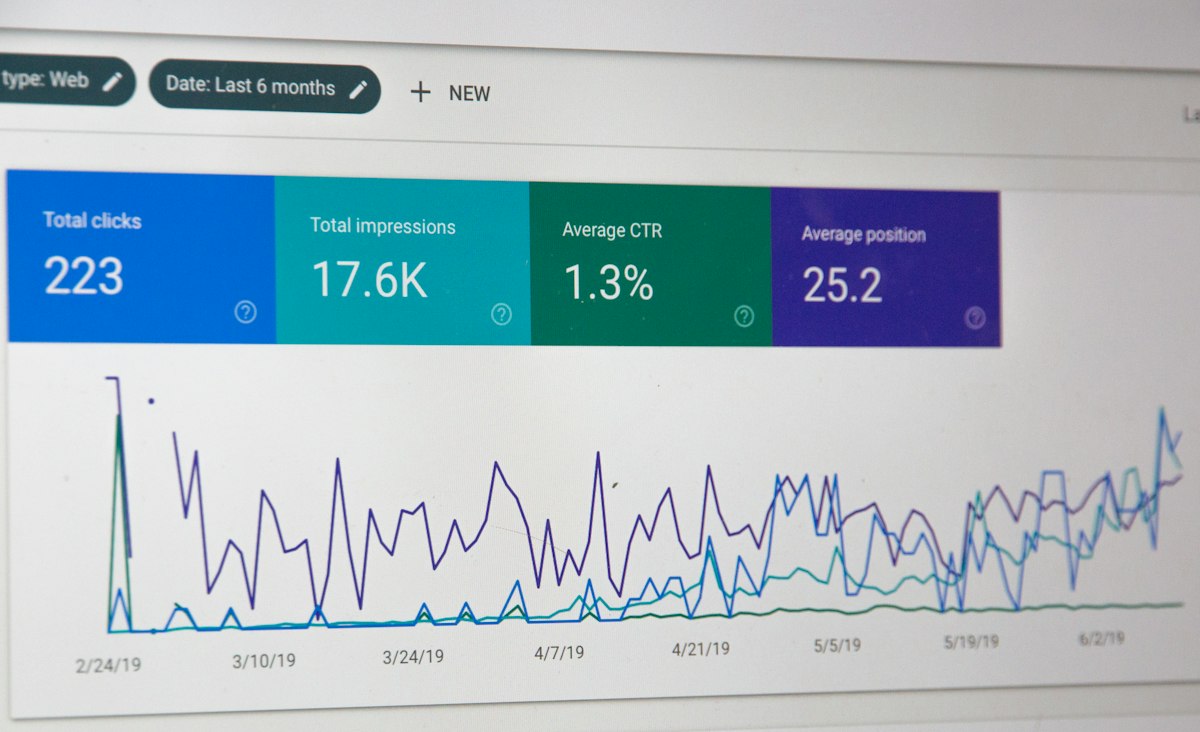
The metrics that matter most sit right inside your Google Business Profile's performance tab: calls, direction requests, and booking or website clicks. These are the actions closest to money. Screenshot them monthly so you can see the trajectory. Beyond that, track your map pack position across your whole service area using a grid-based rank tracker, because ranking first in your own neighborhood while sitting fifteenth across town is the norm, not the exception. Monitor your review velocity, meaning reviews per month, your response rate, and your average rating. Watch your Search Console for the question-shaped queries bringing people to your site, which double as your next content ideas. And keep up the monthly AI visibility spot-checks.
Most small businesses that fix the fundamentals properly see meaningful map pack movement within sixty to ninety days. AI visibility moves on its own clock, with fresh content sometimes earning citations within days but consistent presence taking a couple of months of sustained effort. Patience paired with consistent tracking is what separates the businesses that climb from the ones that give up right before it works.
Put Your Local SEO Checklist Into Action
Local SEO in 2026 rewards businesses that show up as complete, active, trusted entities across every place their customers look. No single tactic wins on its own. It's the combination that compounds: a thorough local SEO audit to find your gaps, a fully optimized and actively maintained Google Business Profile, a steady flow of recent reviews, consistent information everywhere, a fast website built for local search with real location and service content, helpful local content, relevant community backlinks, deliberate optimization for AI answer engines, and disciplined tracking of the metrics that map to revenue.
Start with your Google Business Profile, since that's where you'll see the biggest and fastest return. Then build your review system, strengthen your website, and layer in content, links, and AI optimization over time. Work this checklist top to bottom, keep at it consistently, and you'll build the kind of durable local visibility that keeps customers finding you long after your competitors have given up.
Need Help Working Through This Checklist?
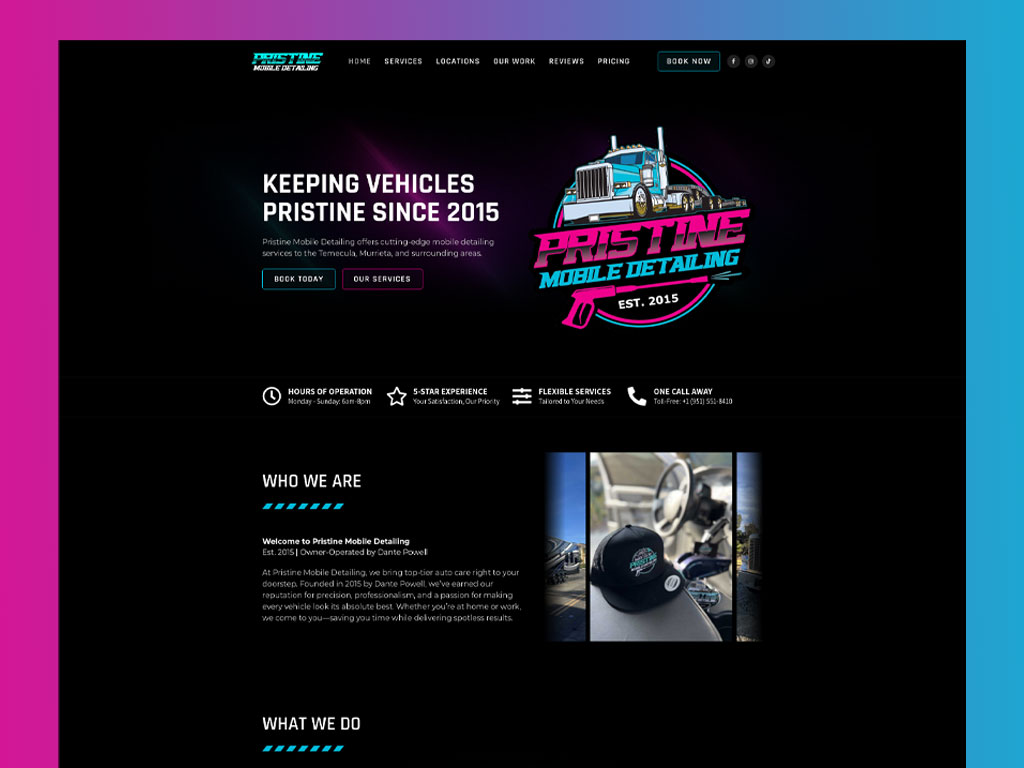
At Murrieta Marketing, this is exactly what we do for small businesses across Murrieta, Temecula, and Southern California. We run the local SEO audit, optimize and maintain your Google Business Profile, build websites engineered to rank for local keywords, and put the full system in place so you show up first when local customers search. It's the same approach that got our client Pristine Mobile Detailing to #1 for local keywords like "Murrieta Mobile Detailing."
If you'd rather spend your time running your business than working through this checklist yourself, reach out to Murrieta Marketing today. Let's build the local visibility that keeps your schedule full.

Pierce Bryant
Founder of Murrieta Marketing — helping local businesses across Murrieta, Temecula, and Southern California get found, get chosen, and grow through SEO, web design, and digital marketing.